TEA5767 is electronically tuned FM stereo radio receiver comes from NXP for low voltage applications. TEA5767 based radio modules are now common in the field and this project is based on Samsung TT-502 radio module. The main objective of this project is to design low-cost FM tuner based on this TT-502 / TEA5767 module and commonly available electronic components.
In this receiver the main controller is ATmega8 MCU, except to that TDA2822 is used as AF power amplifier, PT2257 is used to control the volume. In this given design MCU, PT2257 and TEA5767 radio module are set to work with a 3.3V power source. The LD33V voltage regulator is used to obtain 3.3V from the supply voltage.
To control the receiver, MCU provides five push buttons. Those can be used to control volume, perform an automatic scan and manual tuning.
The firmware of this receiver is developed using MikroC for AVR and it is available to download with project package.
This receiver is design to drive using 9V - 12V DC power source and we recommended using regulated AC power supply to drive this tuner.
While at the testing we got very good results with this tuner and it performs similarly to the commercial grade portable FM stereo radio receiver. All the schematic and firmware related to this project are available to download at google drive.
In this receiver the main controller is ATmega8 MCU, except to that TDA2822 is used as AF power amplifier, PT2257 is used to control the volume. In this given design MCU, PT2257 and TEA5767 radio module are set to work with a 3.3V power source. The LD33V voltage regulator is used to obtain 3.3V from the supply voltage.
To control the receiver, MCU provides five push buttons. Those can be used to control volume, perform an automatic scan and manual tuning.
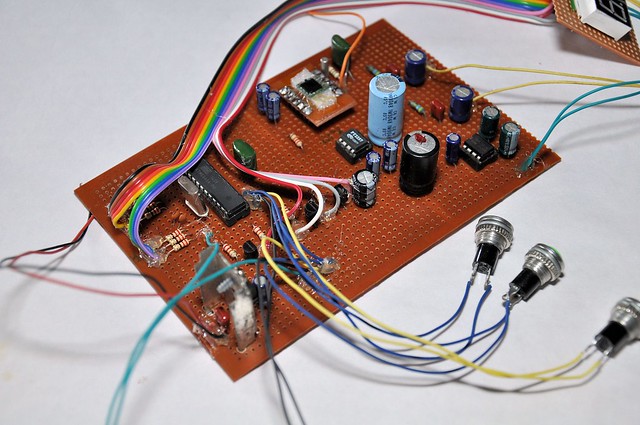 |
| The final version of TEA5767 based FM radio receiver. |
The firmware of this receiver is developed using MikroC for AVR and it is available to download with project package.
This receiver is design to drive using 9V - 12V DC power source and we recommended using regulated AC power supply to drive this tuner.
While at the testing we got very good results with this tuner and it performs similarly to the commercial grade portable FM stereo radio receiver. All the schematic and firmware related to this project are available to download at google drive.
Comments