Project Profile Post (3P) is an open source XML base project description suite. It it helps authors to provide project descriptions and specifications to online sources in a standard way. 3P project description system is not limited for software projects, it can also applicable for any online project work which include electronic projects, arts, multimedia content, etc.
3P files can created through 3PEd. It is a GUI application and available for both Windows and Linux operating systems. 3P files can be open (view) through "3P Viewer". 3P Viewer is a GUI application and it is also available for both Windows and Linux operating systems.
Initially we create this file format and tools to manage our in-house digital contents and later we plan to release it to general public as a free and open source software product(s). 3P tools are available to download at 3P project page at sourceforge.net and it is distribute under the terms of MIT licenses.
In this general public release we add additional component to 3P tool chain and it is known as 3P API. 3P API is a software library to access 3P files. This library is available for both Windows (as DLL) and Linux (as SO) operating systems and it can be access through any programming/scripting language which support dynamically loadable libraries (e.g: C++, Delphi, C#, VB.net, etc.).
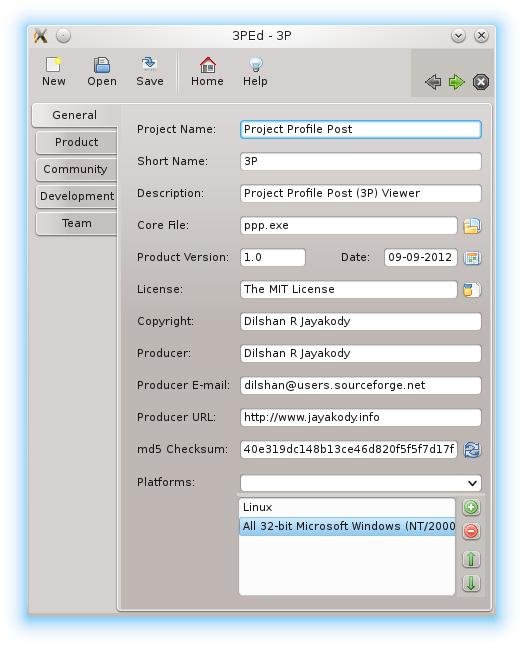 |
| 3PEd - Cross platform tool to edit 3P files |
3P files can created through 3PEd. It is a GUI application and available for both Windows and Linux operating systems. 3P files can be open (view) through "3P Viewer". 3P Viewer is a GUI application and it is also available for both Windows and Linux operating systems.
Initially we create this file format and tools to manage our in-house digital contents and later we plan to release it to general public as a free and open source software product(s). 3P tools are available to download at 3P project page at sourceforge.net and it is distribute under the terms of MIT licenses.
In this general public release we add additional component to 3P tool chain and it is known as 3P API. 3P API is a software library to access 3P files. This library is available for both Windows (as DLL) and Linux (as SO) operating systems and it can be access through any programming/scripting language which support dynamically loadable libraries (e.g: C++, Delphi, C#, VB.net, etc.).
Comments