
Sony TC-500 reel to reel player restoration

TC-500 is 4 track stereo reel to reel player which is built around 1960 - 1970 by Sony Corporation. This is vacuum tube base reel to reel player with 2 × 3W audio output power. TC-500 is dual speed (3¾ and 7½ ips) tape recorder and it support reels up to 7 inches (18cm). Amplifier stage of this tape recorder is built around 12AX7, 6AU6 and 6AQ5 vacuum tubes and the 12BH7 tube is used in biasing oscillator. Other than above tubes, 6CA4 is used in PSU for rectification.
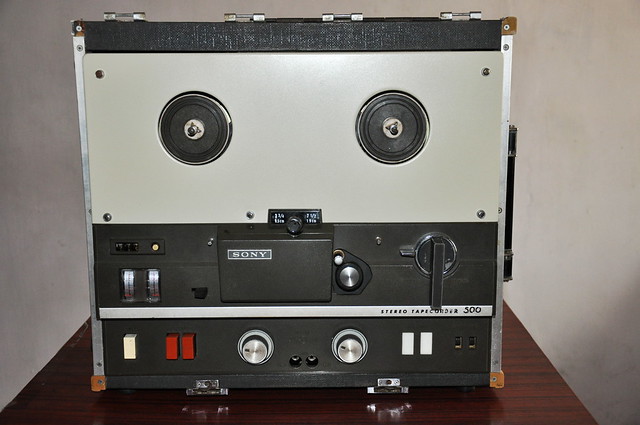
Restored Sony TC-500 reel to reel tape recorder.

Recently we got a chance to restore TC-500 reel to reel player which we got from our friend. The player which we got is heavily damaged and we spend nearly 2½ months to restore this player.

In the first stage of restoration, we disassemble mechanical parts of this player and clean everything. In this player capstan idler wheel and take-up, idler wheel is damaged beyond repair and we reconstruct those wheels using rubber sheets.

Disassembled TC-500 reel to reel tape recorder.

In the second stage we dismantle amplifier and power supply circuits of this player and replace all the capacitors and some damaged electronic components. After restoring the circuits we rewire the unit because most of the wires are damaged due to corrosion.

The restored amplifier of TC-500 tape recorder.

The most time-consuming part of this project is the restoration of output transformers. We rewind 2 output transformers of this unit with new copper wires and it took nearly 2 weeks to complete this job.
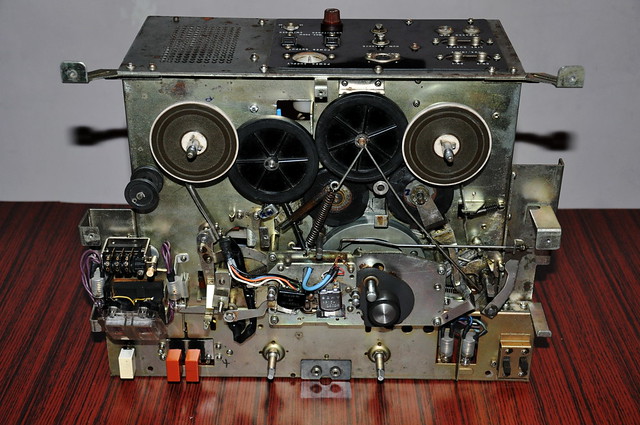
Restored mechanical assembly of Sony TC-500 reel to reel tape recorder.

After above fixes and calibrations we test this unit and it produces very good results. The speaker pair which comes with this player is not very good but when it couples with large professional speaker system it gives excellent sounds.
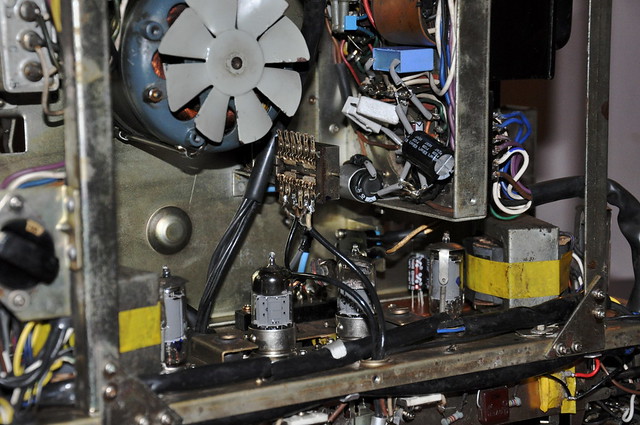
Motor, output transformers and PSU of restored Sony TC-500 tape recorder.

Schematic and services manuals of TC-500 is available in lot of internet sites, which including hifiengine.com or at radiomuseum.org.

Comments

Popular posts from this blog

Building the TD4 4-Bit CPU

The TD4 is a famous 4-bit CPU featured in the book How to Build a CPU by Kaoru Tonami . The book focuses on constructing a functional processor entirely from basic 74-series TTL logic ICs. While the book is unfortunately only available in Japanese, a friend from Japan sent me a copy along with a TD4 PCB. I believe the PCB is based on the open-source design files available on BG5DIW's GitHub repository . "How to Build CPU" book and the PCB. Recently, I finally found the time to build and experiment with it. The project took a few months, as I had to translate the book myself to grasp the core concepts. The overall design is simple and elegant, offering a set of 12 instructions and a 16-byte ROM (implemented via DIP switches) for programming. The board operates on 5V and can be powered via USB. Most components were sourced from local shops, though I had to order a few 74HC-series ICs online. Later, I tested the circuit by replacing some 74HC components with 74LS series...

CD2003 - yet another simple FM radio receiver

In the last few days, we are looking for some simple FM radio receiver to integrate into one of our ongoing projects. For that, we try several FM radio receiver ICs including TDA7000, CD2003/TA2003/TA8164, CXA1019, and KA22429. Out of all those chips we select CD2003 (or TA2003/TA8164) based receiver for our project because of its simplicity and outstanding performance. Except to CD2003, Sony CXA1019 also perform well but we drop it because of its higher component count. We design our receiver based on Toshiba TA2003 datasheet and later we try TA8164 and CD2003 with the same circuit. Either CD2003 or TA8164 can directly replace TA2003 IC, and as per our observations, TA8164 gives excellent results out of those 3 chips. A prototype version of CD2003 FM radio receiver The PCB design and schematic which we used in our prototype project are available to download at google drive (including pin-outs of crystal filters and inductors ). Except for CD2003 IC, this receiver consist...

AVR-HV: High voltage programmer for AVR microcontrollers

When it comes to AVR microcontrollers the most common programming option is In-System Programming ( ISP ). ISP interface is easy to use but in some scenarios it is totally unusable. The most common scenario is with some wrong fuse bit values. For example if we program SPIEN or RSTDISBL fuse bits, AVR microcontrollers may not respond to any in-system programmer(s). To overcome these problems the next available option is high voltage programming mode. In High voltage programming mode, 12V programming voltage is applied to RESET pin of target AVR microcontroller and user can change configuration fuses of AVR MCU with minimum amount of risk. The only drawback in this mode is that target microcontroller must need to be removed from the board to reprogram. Most of the AVR high voltage programmers are expensive and difficult to find in ordinary electronic shops. As a solution we implement USB base high voltage parallel programmer for AVR microcontrollers and it allows programming, readi...