Recently I got an ICOM IC-R71A receiver from my friend. ICOM IC-R71A is a multi-mode quadruple superheterodyne receiver with the frequency range from 100kHz to 30MHz. When it comes to my workshop it's completely dead but outer casing and front panels are in really good condition. Before troubleshooting the receiver, I download both user manual and service manual from the internet. As like all ICOM products this receiver also comes with very detailed user manual and service manual.
As I observed this receiver consist of many PCBs which including:
In addition to above boards, there are some previsions in this chassis to install other optional boards such as FM board.
After observing the power supply board, I notice a couple of dry joints in the rectifier module and 2SD880 transistor. After resoldering, power supply unit starts to work and the receiver got powered up.
After checking it for a few minutes I noticed a couple of problem with this receiver. The main issues which I noticed are faulty RF gain controller and very low audio output from the receiver.
While checking the boards I notice that most of the electrolytic capacitors in this unit are in quite a bad state. I noticed most of the electrolytic capacitors in PLL board are in very bad condition and most of them are in "leaky" state.
After checking other PCB boards, I decided to recap all the electrolytic capacitors in this receiver. I bought all the necessary capacitors from the local market and it costs me approximately LKR 300. For most of the values, I choose Nichicon capacitors because they are commonly available in the local market. For other values, I use Panasonic and ELNA capacitors. Because 10V capacitors are quite hard to find I use 16V capacitors instead. The complete list of capacitors is available in my QSL home page.
I took extra precaution while working with the logic board because it consists with a battery-powered memory module. (According to ICOM, it's DRAM uses this lithium battery to retain its content. If it got erased, the radio may become unusable.)
After replacing all the capacitors receiver starts to work perfectly and I got amazed by its performance. Compare with my existing receivers this receiver performs extremely well and its sensitivity is super impressive.
More details about the restoration is available at https://www.qsl.net/4s6drj/icr71a.html.
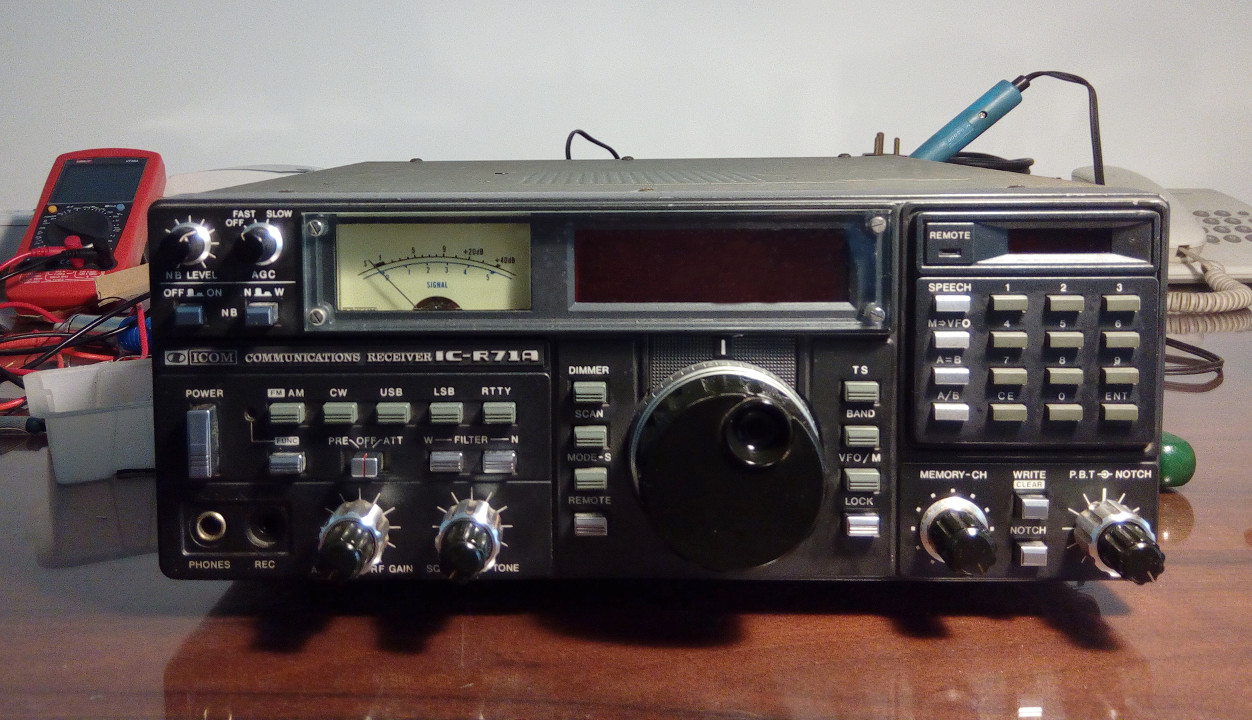 |
| Restored ICOM IC-R71A receiver |
As I observed this receiver consist of many PCBs which including:
- Mainboard
- Front boards (altogether 7 boards, which including 1 mainboard known and matrix board and 6 small PCBs)
- PLL board
- RF board
- Logic board and RAM board
- Power supply board
In addition to above boards, there are some previsions in this chassis to install other optional boards such as FM board.
After observing the power supply board, I notice a couple of dry joints in the rectifier module and 2SD880 transistor. After resoldering, power supply unit starts to work and the receiver got powered up.
After checking it for a few minutes I noticed a couple of problem with this receiver. The main issues which I noticed are faulty RF gain controller and very low audio output from the receiver.
While checking the boards I notice that most of the electrolytic capacitors in this unit are in quite a bad state. I noticed most of the electrolytic capacitors in PLL board are in very bad condition and most of them are in "leaky" state.
After checking other PCB boards, I decided to recap all the electrolytic capacitors in this receiver. I bought all the necessary capacitors from the local market and it costs me approximately LKR 300. For most of the values, I choose Nichicon capacitors because they are commonly available in the local market. For other values, I use Panasonic and ELNA capacitors. Because 10V capacitors are quite hard to find I use 16V capacitors instead. The complete list of capacitors is available in my QSL home page.
I took extra precaution while working with the logic board because it consists with a battery-powered memory module. (According to ICOM, it's DRAM uses this lithium battery to retain its content. If it got erased, the radio may become unusable.)
After replacing all the capacitors receiver starts to work perfectly and I got amazed by its performance. Compare with my existing receivers this receiver performs extremely well and its sensitivity is super impressive.
More details about the restoration is available at https://www.qsl.net/4s6drj/icr71a.html.
Comments